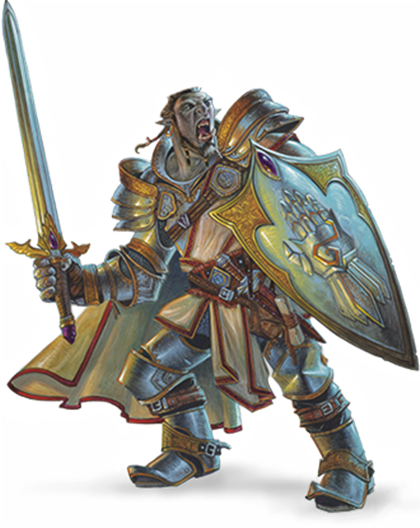
Paladins are known throughout the realm as the “Superman” of all character types. Lawful good, standing firm in their beliefs and in their loyalty – always fighting for the common good. But what if they want to fight for the common evil?
While tricky to build with minimal guidance, paladins of the evil alignment can be created. Most often done by players who are more experienced in Dungeons and Dragons, the wording in 5e leads gives one the green light to build a character like this.
Common Attributes of the Paladin
There are some character elements of the paladin that alignment has little to do with. Looking deeper into the definition of this powerful and proud fighter, here are some of the traits that both good and evil have in common, taken straight from the 5 Edition Player’s Handbook:
- a paladin’s oath is a powerful bond – an oath doesn’t define whether it’s to a deity who is evil or good.
- Although many paladins are devoted to gods of good, a paladin’s power comes as much from a commitment to justice itself as it does from a god – justice is not necessarily an alignment-based characteristic. Justice to one who is evil doesn’t change just because they are evil.
- A delve into an ancient ruin or dusty crypt can be a quest driven by a higher purpose than the acquisition of treasure – who is to say that power is not their higher purpose. a strong self of self above all else could be a sense of purpose.
The Basics of a Paladin
Whether you are seeking out a character type you haven’t adventured into yet; just starting out in the realm of Dungeons and Dragons and thinks “paladin” sounds cool, or have been playing a million years and religiously (see what we did there?) have only ever played a paladin, let’s go over what the overall character breakdown is.
The attributes that most players start within a build are going to whether they are lawful, chaotic, or neutral. These typically help define how the characters decision making is influenced. Is the character always going to play by the rules? Or is she going to go with whatever the group decides is best?
The next thing that is chosen is whether his alignment will be good, evil, or neutral. This is where a challenge often occurs. Most parties are of similar alignment, however, there may be a rare occasion that an evil character might be mixed with a goodly aligned group – or the other way around.
How Can a Paladin be Evil?
Enter the paladin. Paladins are always lawful. Always. Their entire mentality is that of following the rules that they are governed by. These rules can be that of a deity or a king’s rulings.
They follow the tenements that are the very soul of their character. These tenements are not the definition of the alignment they are, however. An evil deity like Tiamat defines the rules of his followers with as much strictness Tyr, God of Justice.
One of the easiest ways to create a great lawful evil paladin is in their story. Many player characters don’t put a ton of thought into who their character really is, how they were raised, where they grew up.
Perhaps a paladin was forsaken in their eyes over and over by following the ways of their good deity until they broke. Maybe they met time and again with followers of a deity who demanded the type of order forefront in their minds.
The world of an evil paladin created before gameplay begins is the easiest way to provide proper justification for their unusual alignment. This also presents a fantastic opportunity for the player to really stretch their creative wings.
Are There Good Examples of an Evil Paladin?
Often, people look to RA Salvatore’s Drizzt as an example of stepping outside the box certain character types have been placed in. The good dark elf Drizzt broke the mold of the quintessential evil of the race, prompting his vast popularity.
So, is there a Drizzt among evil paladins? Yes! Joe Manganiello – actor and famous Dungeons and Dragons player – created the beastly Dragonborn Arkhan. This Oathbreaker paladin and barbarian follows the letter to what a paladin represents, all the while being pure evil.
There have been plenty of examples of players choosing to play their paladins evil, and is especially easier in a campaign of all evil characters. In a few examples, an evil paladin may even go a little rogue, hiding in a group of good to obey the demands of their king or god.
By examining these features of a paladin more closely, one can see that alignment does not have to play the role in paladin creation as much as once was.
Today, through great game evolution, the challenge of playing an evil paladin is viewed as an exciting one, rather one only ever whispered about.
 Solyndria Creative