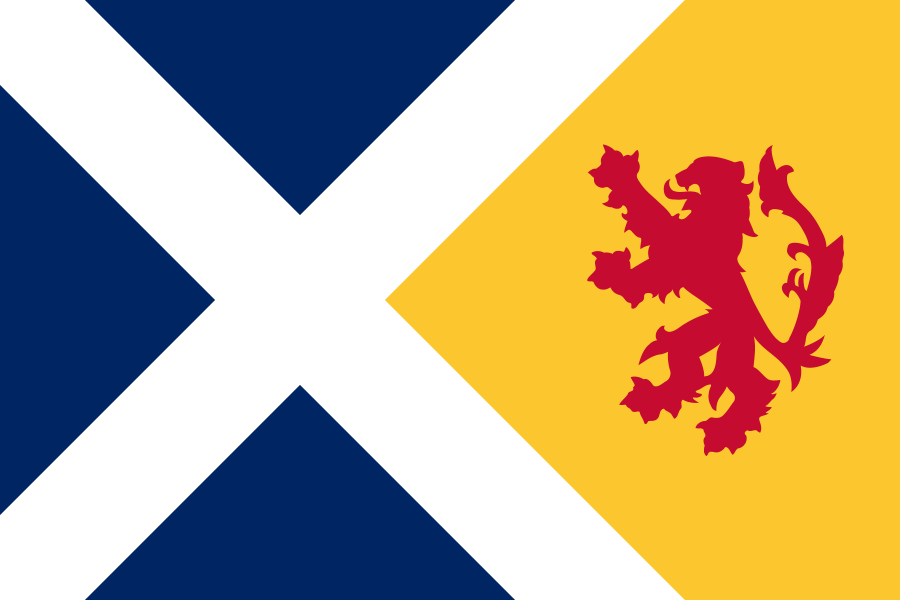
Recognized the world over, the flags of Scotland have flown high in pride for centuries. Scottish flags’ history is a chaotic one, filled with intrigue, exciting stories, and rich symbolism.
We are excited to present the rich history of Scotland’s two fine flags from our family to yours.
When It All Began, Maybe
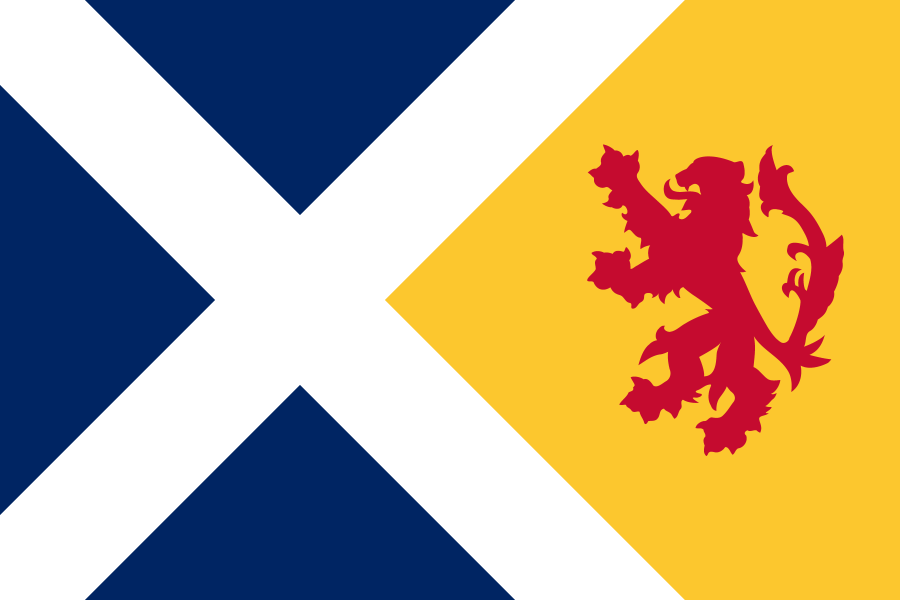
There is a great deal of debate about when the familiar Flag featuring a blue background and Saint Andrew’s cross got its beginning. For certain, the legend begins with the namesake of the type of diagonal cross: Saint Andrew himself. Even his history has some discrepancies.
What is “saltire”?
It’s most commonly accepted that Saint Andrew was an incredibly dìleas (loyal) apostle of Jesus Christ. So devoted, Saint Andrew felt ill at ease being crucified on the same type of cross Jesus sacrificed himself upon. In this version of history, he requested to be hung on a “saltire.” This cross, similar to Jesus’ cross, only shaped like an X.
Another history’s telling says that Saint Andrew was in Greece when he met his crucifixion. In Greece, the most common form of crucifixion was upon a saltire. As such, his end met as common practice, and his feelings about the vehicle of crucifixion irrelevant.
It appears that good Saint Andrew did indeed meet his end on the saltire in any history. As he was such an illustrious figure in history, the saltire’s reputation and the name evolved into Saint Andrew’s Cross.
What does Saint Andrew have to do with Scotland?
Saint Andrew’s connection with Scotland is yet another cause of head-scratching as there are a couple of widely known “facts” of lore. His association with Scotland could have been before or after his death.
Saint Andrew was a traveler, near and far, spreading the word of first John the Baptist, then of Jesus, throughout many a land. As such, one tale would tell that Saint Andrew, taken in by the beauty of Fife, had a church built there. Over the years, his church’s glory transformed the town to Saint Andrew’s in name as well.
Or was his connection a posthumous one?
Relics from the time of Christ made their way to all corners of the world, most lost today – but not so in the few hundred years following his death. Of course, Saint Andrew and the other apostles would have their relics carried in reverence across the land as well. Thus, his relics ending up in Fife, along with words of his greatness, may have prompted paid halò (homage) to the Saint.
Either telling has Saint Andrew becoming the name of a cross, name of a town and honored as the Patron Saint of Scotland (as well as other countries such as Greece).
Wow! And his saltire became the Scottish Flag how?
You may not believe this, but even the correlation to Saint Andrew to the main Flag of Scotland varies in the tale. However, there is a telling that connects the Flag’s aesthetic and how Saint Andrew became patron of Scotland.
In the mid-ninth century, the Picts and Scots banded together to defeat King Aethelstan’s Saxons. These fighters of both Picts and Scots were led in tandem by the Pictish King Angus MacFurgus.
This leader of Picts and Scots was afraid that they bit off more than they could chew. In eagle (fear) of an upcoming loss in the war, he did what great kings did and led his army in prayer. While he and his men prayed, they noticed something strange in the sky.
A blue sky served as a background to the arrival of great billowing clouds, but unlike clouds that are to be seen on any other day. These clouds grew to form a great saltire in the blue sky above.
As he was visited the night before by Saint Andrew himself, Angus could not ignore this mysterious sight after begging in prayer for guidance. The vision of Saint Andrew and the next morn, his cross, bolstered the good King Angus and his army, and through strength and courage, the battle was won.
Thus not only was Saint Andrew granted patronage over the Scottish people, but his cross against the blue of the sky also became so symbolic, it was transformed into the Flag we know and love today. At least, that is the most common tale for THAT Flag.
Wait, there’s a second flag?
While it’s unofficial, Scots are such proud folk; we were unsatisfied with one national Flag – we had to have two. Enter the Lion Rampant.
Prepare to be shocked – this Flag also carries with it some controversy and skewed facts. History shows that it originated with King Richard “the Lion-Heart.” The king’s nickname explains well the standard’s poised-to-fight lion. However, there is plenty of evidence to suggest that this was a symbol of heraldry long before good King Richard – up to several hundred years before.
Depicted against a bright yellow background, some distinctive red scrollwork at its edges, the red lion in all its glory is quite a bit more vivid in look than the official Flag’s Saint Andrew’s Cross.
Even though it’s status is considered unofficial, it’s official enough to be the Bratach rìoghail na h-Alba (Royal Standard of Scotland) and supposed to be ONLY used by the King or Queen of Scotland. It’s been relegated to Queen Elizabeth II, of course, and incorporated into her standards.
Although technically illegal to be flown about by anyone else, due to a loophole created byKing George regarding its use in the Silver Jubilee in 1934, it’s often waved about by sports fans at many sporting events in the United Kingdom.
The Tales of Two Flags
Scottish heritage is rich, adventurous, and diverse. Why would our flags be any different? Their histories are stories passed down from generation to generation. Each Flag carries its own tales and aesthetic. We are proud to offer our teaghlach (family) a wide variety of products that showcase each unique banner.
 Solyndria Creative